

Notes from the dumpster
You're still worthy, even when you feel like trash


You guys.
I had a completely different post written for you. A neat little January offering about capacity and intention-setting and how to choose commitments that match the life you actually have, not the one you think you should have. It was about how even though the cultural drumbeat tells us we should all be in “expand mode” this season, so few of us actually are. Our country sure the hell isn’t. And I can tell you, from convos with my clients this week, it probably would have resonated.
And then life lifed hard.
Like: my three-year-old got a stomach bug, we thought it passed, and then she puked again at 1am on New Year’s Day. (Happy 2026.) I felt awful all that day but pushed through, and then went down hard myself that night. Up all night. So, so sick all the next day. And then Friday morning at 5:45am, my son called me in: he’d thrown up. Five times. All over his wool rug, his bedding, himself.
So here I am, writing from what is, not what I thought it would look like or what I wanted it to be. Knee-deep in the dumpster: trying to salvage something worth keeping.
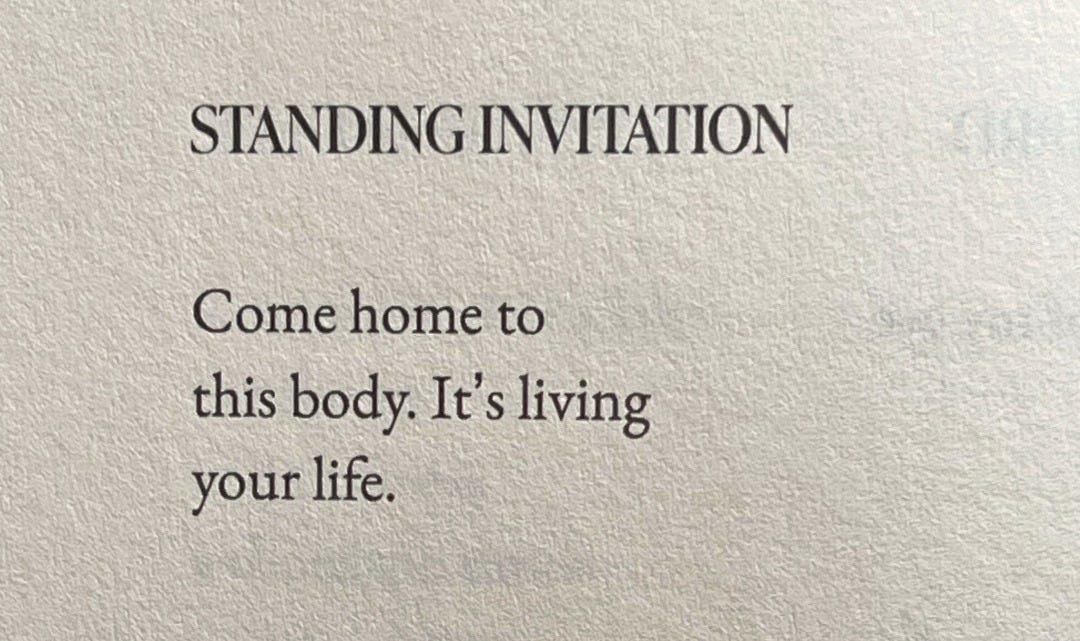
I love that line. I’ve been carrying it around like a little talisman. (James’s book of poetry, The Wilderness That Bears Your Name, is wonderful. Highly recommend.)
But last Friday, standing in my son’s doorway, still nauseous myself, staring at the scene before me like a crime documentary, I had a different thought:
Get me the fuck out of here.
Not just this room. This body. This life. This country. Put it all in the trash can and get me a new one.
“Come home to your body”, the poem says. But what about when you want to leave?
Burn it all down
There are moments when being in a body feels tender and holy and miraculous.
And then there are moments when being in a body feels…gross. Overstimulating. Painful. Unbearable. Like you are trapped inside a malfunctioning meat suit while the rest of life keeps demanding you behave like a cheerful, high-functioning adult. Or while you caretake and scrub someone else’s vomit for an hour when you’re feeling sick yourself.
Sometimes the desire to leave isn’t philosophical. It’s visceral. It’s a nervous system flare. It’s your brain trying to get distance from sensation, emotion, chaos.
If you’ve ever had food poisoning, a migraine, a panic attack, a grief day, a postpartum night, a chronic flare, a depressive episode, a week where the wheels just come off: you know this place.
And I want to say something plainly, because it matters:
Wanting to leave your body when it hurts doesn’t mean you’re doing it wrong. It means you’re human.
A good body
The surprising thing, for me, wasn’t only how sick I felt.
It was how quickly sickness turned into a story about my worth. How quickly I wanted to dissociate.
Not consciously. I know better than to say the quiet part out loud. More like a background program I couldn’t close.
I had plans for how my post-holiday week at home was going to go. I had a vision. I was going to get the holidays packed away, clean the fridge, get a jump on business and life planning, and even have some time to sit on the couch (in my super-clean living room) to do some sewing or reading or journaling. I was going to host a craft night and teach everyone how to make their own customized winter brew of medicinal tea! I was going to start a “no-buy” month.
Instead I was entering 2026 already behind, snapping at my family, wanting to throw away everything in my house that wasn’t bolted down, with Christmas still not put away and my husband probably next in line for the bug.
And underneath the nausea was this:
I shouldn’t be triggered like this.
I should be healthier than this.
I should be more resilient than this.
I teach about being in your body, and I just want to get out of mine.
And that’s the part I’ve been thinking about on my walk today: how being unwell doesn’t just feel bad: it can also make you feel unacceptable. Unlovable. Like you’ve slipped outside the narrow band of what gets to be valued in this culture.
Not because anyone said it to you directly (though sometimes they do).
But because we live inside a kind of cultural logic that constantly whispers:
A good body is healthy.
A good body is high-functioning.
A good body is disciplined enough to stay that way.
A good body is calm, regulated, productive.
A good body doesn’t derail plans.
A good body doesn’t require accommodations.
A good body is easy to live in — and easy to live with.
This is where “coming home” gets complicated.
Because what if part of why we want to leave isn’t only the sensations?
What if part of it is the shame we’ve been trained to feel when our bodies are messy, limited, sick, fat, disabled, aging, grieving, postpartum, perimenopausal, neurodivergent, chronically inflamed, hormonally chaotic, not “high-functioning,” not optimized?
There’s a word for this: healthism. This is the idea that health is primarily an individual responsibility and, more than that, a kind of moral status. Healthy becomes shorthand for good, disciplined, worthy. Unhealthy becomes a personal failure.
And when healthism is the water we’re swimming in, illness doesn’t just disrupt our plans.
It threatens our belonging.
It tells us (quietly, relentlessly): If you were doing it right, you wouldn’t be here.
Aubrey Gordon talks about this eloquently. How even the mainstream “body positivity” world often expands the circle only slightly, leaving a pretty tight set of bodies still deemed acceptable: not too fat, not too sick, not too disabled, not too unruly, not too outside the lines.
There are such narrow parameters for what gets to be lovable.
And if you think about it for five seconds, it’s obvious why that’s a problem:
Bodies do not stay inside parameters.
Bodies change. Bodies break. Bodies leak. Bodies swell. Bodies scar. Bodies need. Bodies rest. Bodies stink. Bodies age. Bodies get sick for reasons that have nothing to do with merit or effort.
If lovability requires staying within a narrow window of “healthy enough” and “functioning enough,” then none of us gets to stay lovable for long.
Which is…a pretty shitty deal when you think about it.
Coming home
This is where I’ve been landing, slowly, between loads of laundry and sips of electrolyte water.
Maybe coming home to your body isn’t a vibe.
Maybe it’s a practice of refusing abandonment.
Not in a grand, triumphant way. Not in a “my illness taught me a sacred lesson” way. (Sometimes it does. Other times, it’s just a virus, babe.)
But in a small, stubborn way.
A decision not to add contempt on top of discomfort.
A decision to stop making the sensations mean you are broken.
And honestly? This feels like more than a personal practice right now. With the machinery of cruelty running hot in this country, there’s a similar impulse to check out of everything — to numb, to scroll, to go dead-eyed, to say “I can’t take one more thing.”
But staying doesn’t mean accepting what’s unacceptable. It means refusing numbness. Letting yourself feel what’s true, finding your people, and then taking whatever small, real steps of resistance you can.
Which is part of why I keep coming back to the body. Because the body is where numbness ends. It’s where we can feel what’s real, if we let ourselves. And the way we practice care here is how we learn to keep our humanity out there.
On her podcast this week, Jessica Lanyadoo (who I adore) said something that has been ringing in my ears:
“Just because it’s hard for you doesn’t mean it’s what’s wrong with you.”
Read that again.
Now imagine what would change if you actually believed it. Not as a concept, but as a way you hold yourself when you’re not at your best.
When you’re in pain.
When you’re grossed out.
When you’re struggling.
When your capacity shrinks.
When your body is doing something you didn’t approve.
When what’s happening out there makes it hard to stay in here.
How I came back
A few days after the worst of it, I noticed something:
I no longer wanted to flush my body down the toilet.
She still feels tender. Slow. Not quite at full speed.
But we are back in communication.
And it wasn’t because I had some massive breakthrough. It was because I started doing small things that signaled, I’m still here. I’m not leaving you.
For me, that looked like:
Canceling anything even remotely optional (reduced capacity has a way of clarifying boundaries that my “normal life” self loves to negotiate with)
Keeping food extremely gentle: toast, broth, congee, smoothie, scrambled eggs if I can manage them. I will tell you that this week, veggies have been scarce. I just can’t stomach them.
A short, simple morning meditation — this has been in lieu of a morning movement practice
Letting myself be a little less nice, a little less efficient, a little less “on,” without spiraling into self-judgment about it
One hand on my belly now and then like: I’m here. I’m listening.
None of this is revolutionary.
But it is relational.
It’s the difference between “my body is ruining my life” and “my body is having a hard time and I’m going to stay with her.”
And I guess that’s what I’m making from the mess: the practice of staying.
Here we are
This is not the New Year’s post I thought I was going to write.
But maybe it’s a more honest one.
Because a lot of us are entering this year not from a clean slate, but from the messy middle of something. A body thing. A family thing. A grief thing. A chronic thing. A world-is-on-fire thing.
So here’s what I want to offer, gently and directly:
You are worthy of care, respect, and tenderness even when you can’t tolerate the sensations of being in your own body.
You are worthy of that when you’re sick.
When you’re overwhelmed.
When you’re not functioning at your usual level.
When you don’t look the way you want to look.
When you’re not “doing it right.”
Especially then.
And if you want a few questions to sit with, try these:
Where do I notice the urge to leave my body lately?
What story am I telling about my worth when my body feels bad or my capacity is low?
What standards have I absorbed about what is required for me to be “lovable”?
“As many ways as there are to leave our bodies,” Pearson writes, “there are just as many calling us back.”
May we all find one of those ways this week.
And if you want to tell me, I would love to hear: How’s re-entry going for you? What small act would connect you to your body this week?

P.S. If you’re new here, welcome! I usually I include a recipe or two in my posts, but not this week because…tummy bug. I’ll be back with some fresh winter kitchen inspiration in the next post: stay tuned!
Beautiful post and deeply honest. Thanks, Lindsay, for not avoiding writing about the really hard things like this that we all face at times!🙏
I really needed to read this today. Thank you for your words, Lindsay.