

What day is it?
A guide to surviving the holidays without losing yourself

My kids have been lighting the menorah this week with unguarded joy, fighting over who gets to place the candles, spinning their dreidel and racking up loot. We decorated our Christmas tree and our gingerbread houses (as one does in a home where you celebrate all the things). Last night we bundled up for the Solstice celebration at Mount Auburn Cemetery—an annual ritual of light and art and sound and awe.
And also: I am absolutely gutted by what’s happening in the world. The callousness. The breathtaking cruelty. The sheer number of tragedies landing in a single week. The willful inaction of people with the power to do something. To demonstrate a shred of compassion, common sense or genuine leadership. If you are anything like me, you are holding a bottomless well of grief and rage and fear alongside your holiday planning.
I wrote a while back about being in a body while the world burns. Everything in that piece feels true again (still…even more) now.

This post is about something smaller: how to get through the holidays without losing yourself. But underneath that, it’s about something bigger: how we stay human when so many things feel inhumane. How do we stay tethered to ourselves so we can stay connected to one other, even when everything feels like it’s coming apart at the seams.
A small offering
I always think I’m going to use the holidays to get ahead.
I’m going to exercise every day. I’ll bring my journal and do a little end-of-year reflecting, a little new-year visioning. I’ll finally have the spaciousness to think, to rest, to be intentional. Time will slow down, and I’ll use it beautifully.
And then I’m at my parents’ house in Kentucky. It’s 2pm: I’ve been up since 5AM with kids on a time-change, eaten nothing but carbs, haven’t been outside, showered or even changed out of my pajamas, and I’m not entirely sure what day it is.
Here’s what I’ve come to understand: the holidays fill us up in so many beautiful ways and they deplete us in others.
They give us things we can’t get any other time of year: connection, beautiful traditions, time and presence with people we love, and a break from the relentless pace of regular life.
And they crowd out things we rely on the rest of the year: our routines, our sleep, our sense of autonomy, our usual ways of caring for ourselves. (I’m also occasionally inclined to revert to the emotional patterns of my fifteen-year-old self, therapy be damned, but that’s a topic for another post…)
Both things can be true. What I’ve found is that when I narrow the chasm between what I expect the holidays to be and what they actually are, the whole thing gets a lot easier.
Reality check
In my fantasy version, the holidays are restorative. Time opens up. I sleep in. The weather accommodates long walks, and I find the perfect quiet spot in the house to do yoga. My kids sleep in and wake up happy and play peacefully with their cousins. All snow is the fluffy, dry, snow globe variety. I sit by the fire with a book. I feel rested and grateful and ready to start the new year refreshed.
In my actual reality, the holidays look more like this:
My time isn’t mine. I’m technically “off” of work, but I often feel more depleted than a regular week, and I’m usually still fielding emails or squeezing in a couple of rescheduled client sessions. I’m parenting more than usual: managing kids in a different time zone in a less familiar (albeit completely wonderful) environment, navigating logistics without my usual support systems, being “on” for extended family in ways that can drain as much as they sustain me. I’m eating outside my comfort zone, sleeping sweatily in a bed that isn’t mine (hello, back pain, my old friend), running on someone else’s schedule. And usually all of this at the tail end of a month of less self-care, more social commitments, longer work days and all the added mental load of Holiday merrymaking.
And the kitchen. The kitchen is the gathering place, the hub, the cozy room everyone wanders into when they don’t know what else to do. There’s always food out. I find myself grazing not because I’m hungry but because I’m there, and the food is there, and time is moving strangely and I don’t have anywhere else to be.
I usually drink more. My sleep quality tanks. By the time I get home, my body is crying out for my own rhythms: my own bed, my own food, my own routines.
I’m not really a “cleanse” person. But after the holidays, believe me, sometimes I understand the impulse.
Lower the bar
Over the years, I’ve realized something important: the holidays are not the time to optimize. They’re a time to just “keep the lights on.”
In Body Partnership, I call this sustain mode.
Sustain mode means accepting that this particular stretch of time is structurally hostile to your best intentions. Maybe you’re in someone else’s space, someone else’s kitchen, someone else’s schedule. Or maybe your own home is suddenly full of family, your fridge stocked with things you didn’t buy, your routines interrupted by people you love. Either way, your usual anchors and rhythms are probably out the window.
So instead of trying to be your best self, I suggest that you aim for something simpler: just don’t lose yourself.
My “sustain mode” list
For me this year, it’s three things. And I mean seriously three things:
Eat protein at breakfast. Not a balanced breakfast. Not necessarily my usual breakfast. Just some protein to anchor my blood sugar before the day goes sideways. For me this has become a non-negotiable. I just feel too crappy otherwise.
Move my body somehow. A 15-minute walk down the driveway in the snow. Stretching in the living room. Walking lunges in the front hall while the kids play. Even a “Frozen” or “KPop Demon Hunters” dance party with the 3-year-old set will do. Anything that reminds me I have a body and it feels better when it moves. At a loss for ideas? My friend Anna Maltby has an excellent Substack called “How to Move” with accessible, body positive workouts each week, many with no equipment required.
Drink water. I’m generally a rock-star on the hydration front because I sit at my desk talking to clients all day long with a big-ass water bottle next to me, sipping as I work. When I’m out of my routine this habit needs some help. I’ve started bringing my big Owalla with me when I travel – handy to avoid $10 water at the airport, and helpful once I’m there to have a concrete goal of draining and refilling it at least twice each day. Sometimes I even add a little pinch of electrolytes to make the whole process a little sexier (I’m into the raspberry flavor of these Superieure ones right now, introduced to me by a dear client.)
That’s it. That’s the whole list.
And here’s the thing: I don’t even always hit all three every day. Some days I get one. That’s sustain mode. The bar is low by design.
Why this works
A lot of what I do with clients this time of year is help them set their expectations even lower than they think they should.
Because here’s what happens when you set ambitious goals for a period that can’t support them: you fail. And then you feel bad about failing. And then you start January already behind, already in a shame spiral, already feeling like you need to make up for lost time.
But if you set your sights low enough that you can actually hit them? You come out of the holidays feeling like you maintained something. You kept one thread. You didn’t completely lose the plot. You stayed connected to yourself.
The psychological difference is huge. “I kept the lights on” feels completely different from “I have to rewire the whole damn house come January.”
Now, if you’re reading this thinking, “Au contraire, mon frère: I have two weeks at home! I’m motivated and I have the supports and structure I need to keep this self-care train rolling,” then sustain mode may not be your move. You might be in expand mode: a season for building, not just maintaining. If so: love that for you. Skip ahead to the recipes, my friend. You’ve got this.
What the holidays do give us
I don’t want to make this sound like the holidays are miserable. They’re absolutely not. Even if you don’t believe in santa (or “Hanukkah Harry” for any of my old school SNL peeps), there’s a steady thread of magic running through the season. It’s hard to name but easy to feel. And it doesn’t really exist outside this window.
It’s why we do this every year: the comfort of tradition, the particular joy of being with people we love and don’t see often enough, the way time slows down from the usual pace of work and obligation. Children opening presents with unparalleled glee and reckless abandon. Late-night conversations. Afternoon boardgames. The feeling of being held by something bigger and a bit more sparkly than your regular life.
The holidays fill buckets that don’t get filled any other time of year. Sustain mode is what makes it possible to actually receive those gifts, because it keeps your own foundations intact. You stay regulated enough to take in what’s beautiful, instead of spending the whole time fighting a losing battle to also be your best damn self.
About that holiday food...
About the kitchen being a constant display of edible possibilities…One thing that’s helped me – and that I share with clients – is a simple question to ask yourself before eating something that’s just sitting there:
Would I order this at a restaurant?
In other words: is this something I actually want? Something I’d seek out? Or is it just...there?
If it’s truly something you love: your mom’s famous rugelach, that one weird family dessert that is objectively absurd and still somehow perfect, the cheese dip you hover over every year like it’s your job? Then yes. Enjoy it. That’s what the holidays are for. (In my case, it’s my mom’s Kuchen, and she makes a special little gluten-free one on Christmas morning just for me! Wheee!)
But most of what tempts us during the holidays isn’t actually that tempting. It’s just around. And available isn’t the same as desirable. One of my clients calls this “The Pumpkin Roll Problem.” She doesn’t even like pumpkin rolls, but there she is every year, eating it anyway and thinking “Whyyyyyy???” with every bite. That’s the gap between what’s around and what you actually want. Noticing it can save you a lot of mindless eating and the vague regret that follows.
If you’re not sure, take one “reconnaissance bite” and channel your inner snobby food critic. Seriously: pretend you’re getting paid to be discerning. Is this a 9 out of 10? Then by all means. If it’s a 4 out of 10, we’re done here. Chimi-chuck it in the bin. You’re not obligated to finish something just because you started it. The first bite is intel. If it’s not excellent, you’re allowed to walk away.

Pack your safety snacks
One more strategy that’s helped me: stock the house (or your suitcase) with a few things you know will make “sustain mode” easier. This might be Greek yogurt, eggs, or cottage cheese for that protein-at-breakfast goal. Your favorite non-dairy milk for your non-negotiable morning latte. That bar that actually satisfies mid-afternoon cravings without making you feel like crap. Some crudités to add to the cheese board or greens to make a salad. Offer to do a grocery run so you can pick up some items that work for you, or send a delivery ahead—I’ve done this with Thrive Market in past years.
And consider bringing a dish to the gathering: a big beautiful salad, a quinoa pilaf, a healthy(ish) dessert. Something you can fill your plate with and feel genuinely good about eating. If you’re the one hosting: all the better!
You’re not being rigid or high maintenance. You’re being strategic about having options that actually feel good, so you’re not white-knuckling your way through a week of foods that don’t serve you. If you can fill half your plate with colorful fruits & veggies at one or two meals per day and start your day with some protein? You’re way ahead of the game, my friend.
Here are two recipes I love for exactly this purpose:
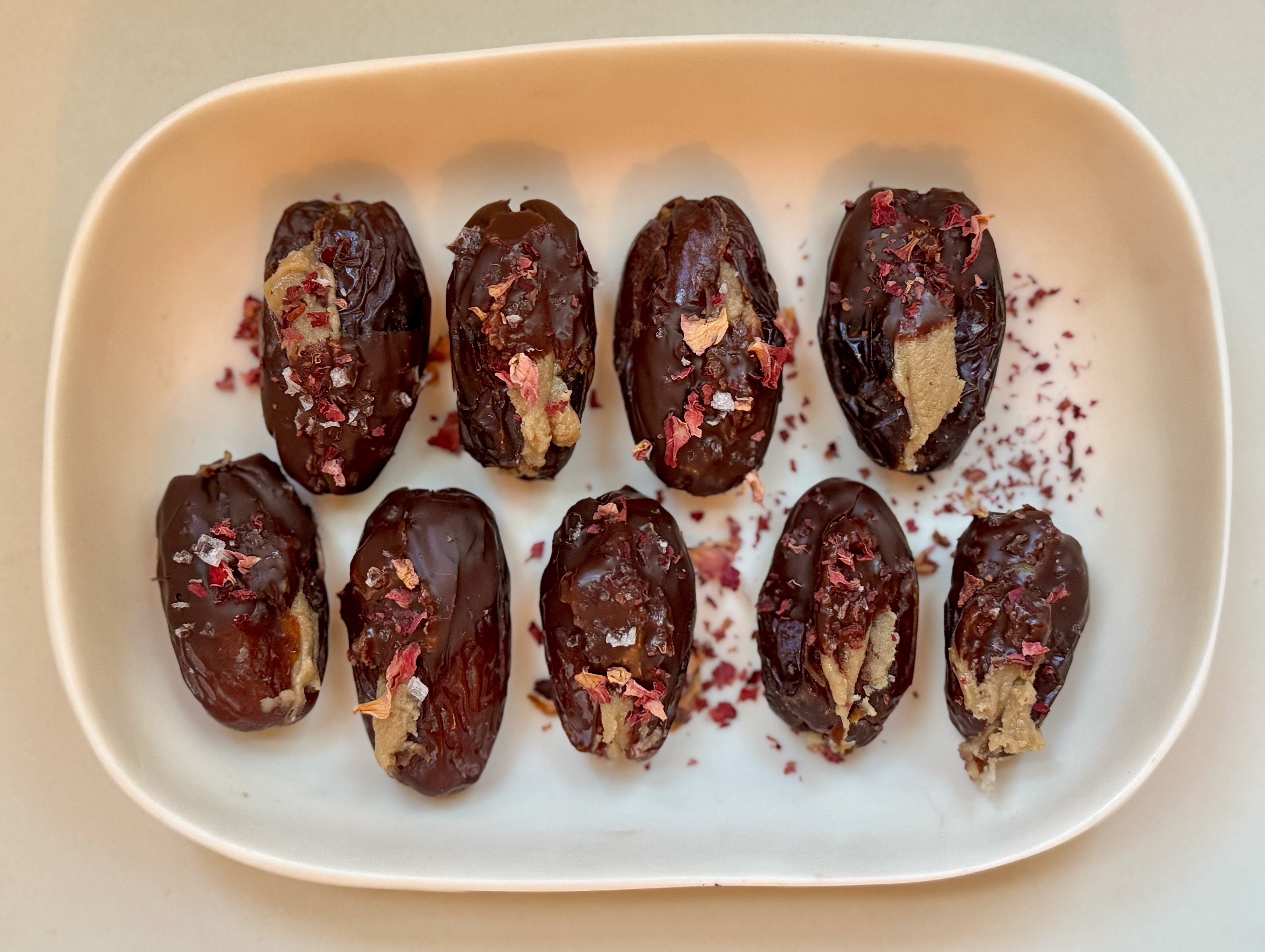
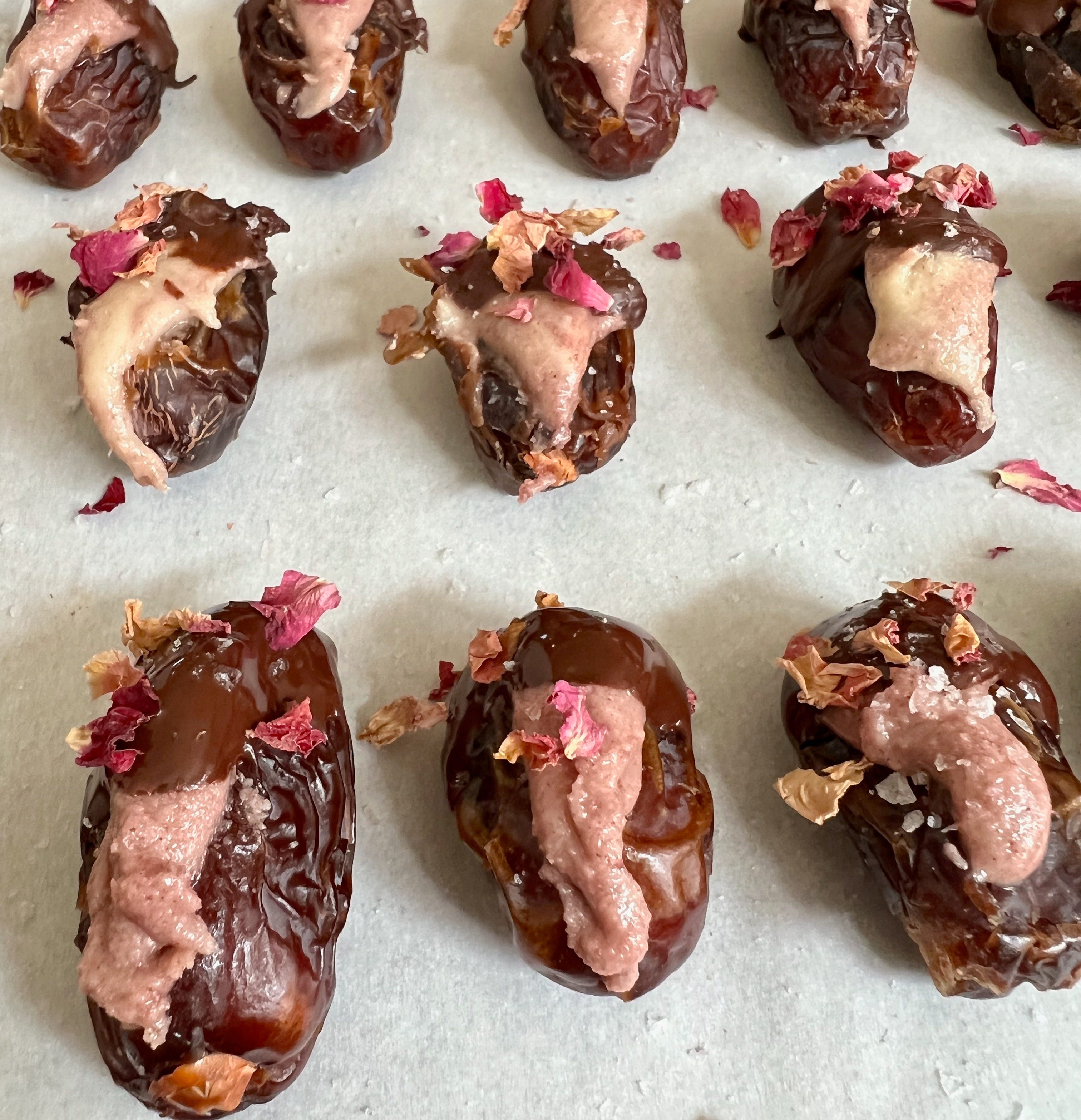
Tahini-stuffed Dates with Dark Chocolate
These are my go-to when I want something sweet that actually satisfies. The tahini and dates give you some substance, and the dark chocolate makes it feel like a real treat. Plus: they’re so pretty!
Ingredients:
12 large Medjool dates, pitted
1/4 cup tahini (let it come to room temp and make sure it’s mixed well)
1/4 teaspoon ground cardamom
1/4 teaspoon ground cinnamon
1 teaspoon maple syrup (optional)
Flaky sea salt, a generous pinch, plus more for sprinkling on top
1 tablespoon rosewater (add by the teaspoon, to taste)
1/4 cup dark chocolate chips, melted
edible dried rose petals, optional, but extra lovely
Instructions:
Split the pitted dates down the middle to make room for the filling. I usually place these on a sheet of parchment paper, to start.
In a small bowl, mix the tahini, cardamom, cinnamon, maple syrup, and sea salt.
Slowly add the rosewater, a teaspoon at a time, mixing thoroughly—the tahini will thicken as you incorporate it. Continue until you have a creamy paste. (If you need to thin it, add cool water by the half-teaspoon, continuing to stir vigorously until well assimilated.)
Stuff small spoonfuls into each date, dip in melted chocolate, and top with flaky salt and rose petals.
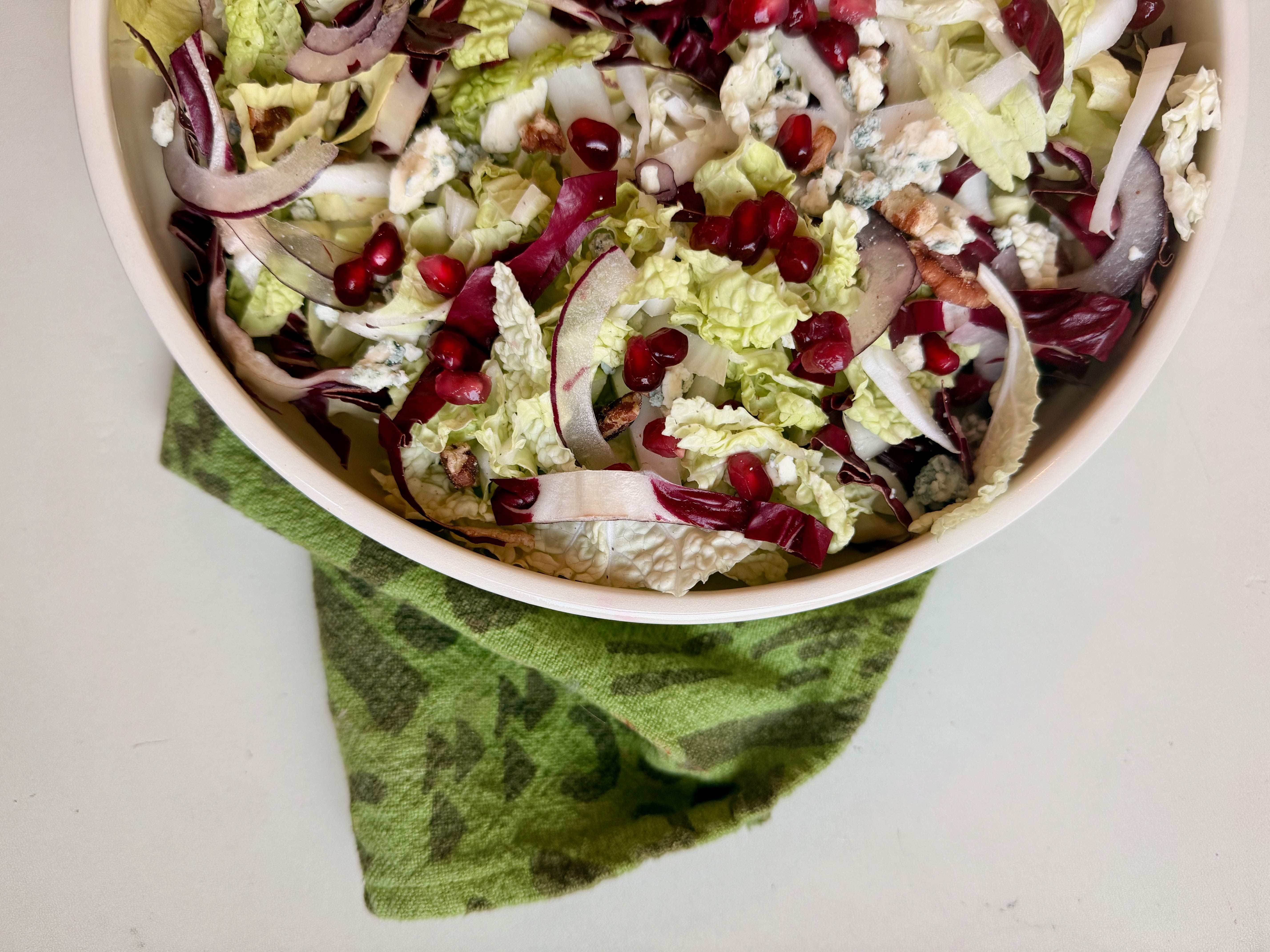
Holiday Napa Cabbage Salad
This is my remix of my Manu’s famous “celery cabbage salad” salad that she served every year at her tree trimming party, alongside her famous vegetable beef soup and herbed garlic bread. It’s crunchy, bright, and hearty enough to anchor a plate full of holiday food. My holiday additions were the raddichio, pomegranates and pecans, and I like a little less onion than she used, but you can increase that if you’re a big onion lover, or cut it out if raw onions make you queasy.
Ingredients:
1/2 head napa cabbage (include some of the super crunchy bits toward the bottom), sliced thin
1/2 small head of purple radicchio (or less, if you’re sensitive to bitter)
½ to ¼ red onion, halved and sliced thin, separated into half-moons
½ cup crumbled blue cheese (or more or less, depending on your taste – I just dump a good amount in so that there’s a little piquant blue in every bite)
pomegranate seeds (a good, hearty sprinkle)
toasted, chopped pecans (about the same amount as pomegranate seeds)
Dressing:
1/4 cup apple cider vinegar
3/4 cup olive oil
1/2 teaspoon sea salt a good dollop of grainy or Dijon mustard freshly ground pepper to taste
*This will make extra dressing; just keep it on your counter to use for future salads – your future self will thank you.
Instructions:
Add your napa cabbage and radicchio to a big, wide salad bowl. Combine cabbage well with onion and blue cheese. If you prep this ahead, I would wait until close to serving time to add the pecans and dressing, as the pecans are best crunchy. That said, this because of the heartiness of the napa cabbage, the salad won’t get soggy like tender greens are wont to do – we happily eat leftovers the next day.
Before you go
If you’re heading into the holidays (or already in them), try this:
Ask yourself: What are the two or three things that will help me feel human?
Not ideal. Not optimized. Just: “What’s the minimum that will keep me connected to myself?”
Write it down. Keep it simple. And when you inevitably miss a day or eat the cinnamon bun for breakfast without some eggs or skip the walk—let it go. The point isn’t perfection. The point is maintaining enough of a thread that you don’t have to rebuild from scratch in January.
And when your basics are covered, you have more bandwidth for the magic. And for the grief. For lighting candles in the darkness, literal and otherwise. For sitting by the fire with a friend or family member while the world rages outside. For staying soft enough to witness what’s happening, and sturdy enough to keep going.
The horrors persist. But so do we, my friends. So do we.

PS: If this resonated with you, it would be such a gift to me if you would hit the heart button, leave a comment sharing your thoughts, subscribe for more body partnership wisdom, and share with a friend who might need this message today.
Yes!!!!