

Learning to give from fullness
Tend, then offer, and soup


“To those to whom much is given, much is required.”
That framed needlepoint sat on my grandmother’s desk my entire childhood. It wasn’t just a decoration: it was a map for how to live. An expectation woven into everything she touched.
The women in my family taught me what deep care looks like.
They show up. They make things happen. They hold community together with fierce, relentless love. Growing up, I watched them build lives around service — to family, to friends, to causes they believed in, to their communities. The care was real. Deep. Beautiful. Their generosity shaped everything I know about what it means to be there for people.
I also saw some of the hidden costs of their giving.
Bodies that were rarely fully rested, needs that were rarely fully tended, rhythms that were overridden in service of everyone else’s. I saw what happens when you give from an empty cup — not because you’re doing it wrong, but because the model itself doesn’t account for the giver’s needs.
The model that shaped them said: your worth is measured by what you give. Your needs can wait. Tending yourself feels selfish. Service requires sacrifice.
So I tried to find a different way.
When I was diagnosed with inflammatory bowel disease in my 20s, I had to learn to tend my own vessel. It wasn’t optional. I turned inward — partly out of necessity. I went to therapy. I learned about boundaries and nervous system regulation and filling my own cup first. I built elaborate routines around rest and movement and nourishment. I got very, very good at this work. I needed to.
And somewhere in all that healing, I became aware of a different trap.
Stuck in a loop
The endless optimization loop. Six workouts a week. The perfect diet and supplement routine. An elaborate morning practice. Reading the right books, taking the right courses, seeing the right healers, trying to figure out the exact right practice to unlock whatever blocked thing needs clearing. In bed by 9PM, up with the sun. Rinse, repeat. It became its own kind of extraction — self-directed, navel-gazing.
The self-care machine can run endlessly if you let it. You can stay in that phase forever, tending and tending and never pouring out.
I see this pattern frequently in wellness culture, especially in health optimization and longevity spaces. Always something new to buy. Another protocol to try. Never ready, never good enough. It leaves people feeling strung out, exhausted and confused, not well. And it so rarely pauses to ask: for what? In service of what?
It’s like accumulating wealth that never circulates. At some point, no individual needs another billion optimizations. The abundance needs to flow outward.
Here’s what I’m learning: both models are incomplete.
Overgiving without tending yourself can lead to exhaustion, resentment, even illness. Endless self-optimization without offering can leave you feeling hollow: disconnected from community and purpose.
What I’m reaching for is a third way. An integration.
Tend, then offer (imperfectly)
Last week I made soup for a friend who needed it. Several hours of shopping, chopping, simmering, tasting, adjusting. Then I drove across town to deliver it. I made the choice to do this instead of other things. But I didn’t do it at the expense of my own nourishment. I’d moved my body that morning. I’d slept well. I had capacity, and I chose to pour it out.
Here’s what surprised me: how much that offering nourished me back. I got more from making and delivering that soup than I would have gotten from those same hours spent “checking things off my list”. More aliveness. More participation in something that mattered.
This is what I learned from watching generous women: service feeds us. Not because we get validation or recognition, but because sincere participation in care creates reciprocity. We’re nourished by the act of nourishing when it comes from a place of having enough to give.
And this is what chronic disease taught me: you have to tend the vessel first. You need to know your rhythms. Honor your capacity. Understand your limitations. Nourish your body. That work is necessary.
But it’s not sufficient.
At some point you have to ask: what for?
Self-care as preparation
Jessica Lanyadoo said on her podcast that there’s an astrological transit this week (don’t ask me which one) that helps us get in touch with our body’s ideal pace and rhythms, so we can engage with our passions, creativity and take meaningful action in ways that are sustainable. What struck me is that it starts with befriending your own vessel — your needs, desires, limitations, capacity. But it doesn’t stop there. It uses that self-knowledge as the foundation for sustainable engagement with the world.
Not self-care as an endpoint. Self-care as preparation.
What I’m learning is a model of care that honors both the vessel and the offering. A way of caring that recognizes interdependence. That my wellbeing is not separate from yours. That tending the body is not selfish — it’s preparatory. That sacrifice is sometimes necessary, but not as penance. As participation.
This means learning to discern in real time: What can this body-mind-spirit vessel hold today? When do I have capacity to pour out? When do I need to pull back and replenish?
The answers change. The capacity fluctuates. That’s not a problem to solve. That’s the nature of being a living system in relationship with other living systems.
Learning the edges
I need to be clear about something: this framework doesn’t demand equal circulation at all times. Some seasons require sustained, prolonged tending. Chronic illness. Pregnancy. Major life transitions. Early motherhood. These aren’t detours from “real” service — tending is hard, legitimate work. And reduced capacity in these seasons isn’t a failure to circulate. Often these seasons teach you something irreplaceable about vulnerability, about asking for help, about what it feels like to be on the receiving end. Your capacity to give becomes richer, more nuanced, more human.
Learning to discern capacity is itself a practice. There’s a sweet spot where you’re resourced enough to stretch, to be uncomfortable, to make sacrifices — and still return to center. That offering will feel generative. But there’s also the edge where you’re truly pouring from empty, and that leads to resentment and depletion.
You learn through trial and error. Sometimes you’ll think you have capacity and you’ll give and end up feeling resentful and sick. That’s information. Other times you’ll make the imperfect offering and feel filled back up in ways you didn’t know you were missing — by the community, the creativity, the use of your gifts to ease someone else’s path. That’s also information. Both teach you where your true edges are.
Service is not always comfortable. It won’t always make your ego happy. You might offer imperfectly. You might make soup that’s just okay. (I did! I cooked it too long, and the muffins I baked to go with it were lumpy and ugly but still tasted good.) You might do it wrong or piss someone off or create something messy and human. That’s part of learning. (Simone Seol has been instrumental in helping me understand this — she talks on her podcast and in her program “Together” about how service gets to be imperfect, messy, and uncomfortable. I can’t recommend her work enough.)
If you wait for perfect conditions — perfect capacity, perfect clarity, perfect skill — mostly what you’re doing is protecting your ego from the vulnerability of sincere participation. And gosh, I’m guilty of this more often than I’d like to admit.
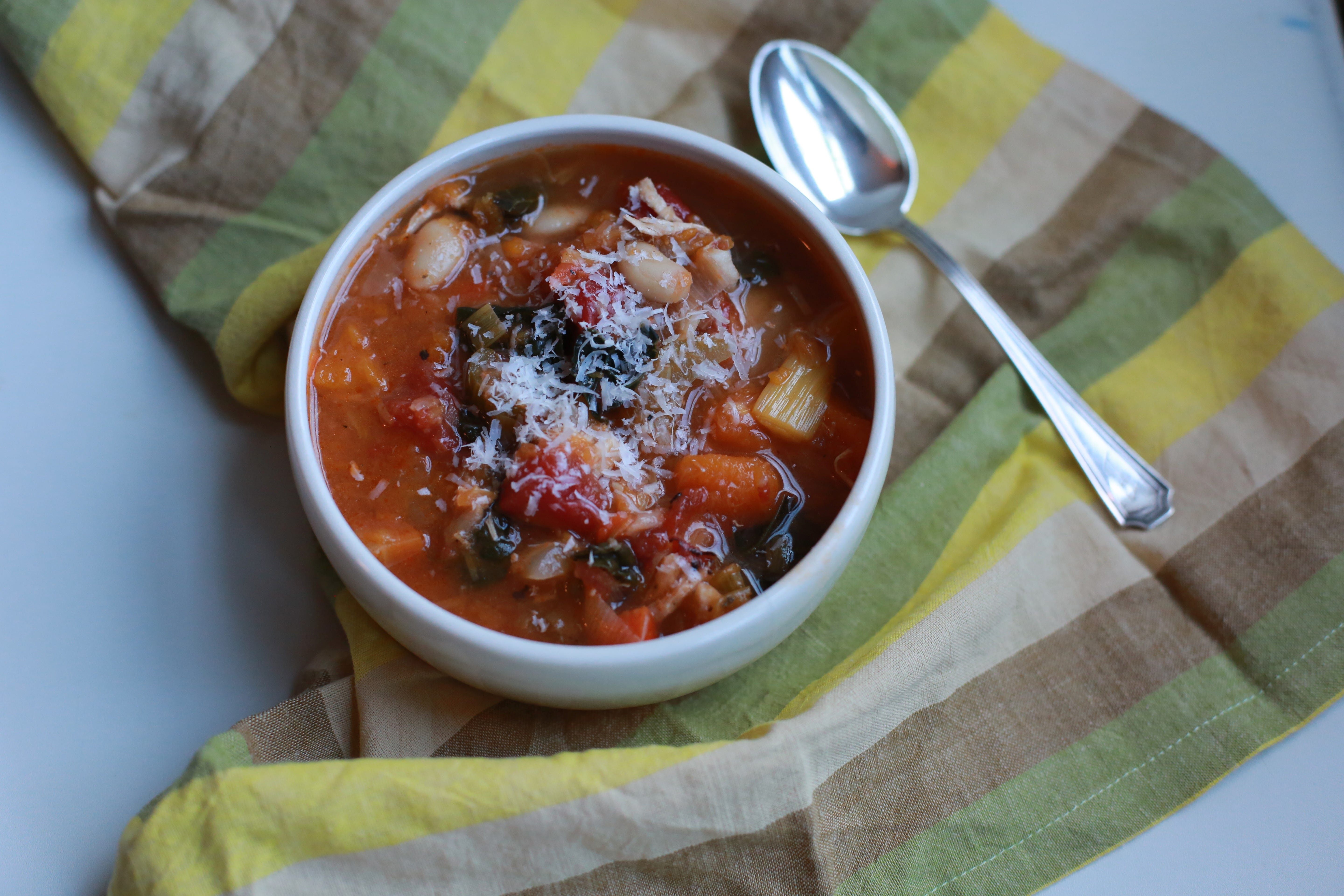
Recipe: Tuscan Bean & Vegetable Soup (Ribollita)
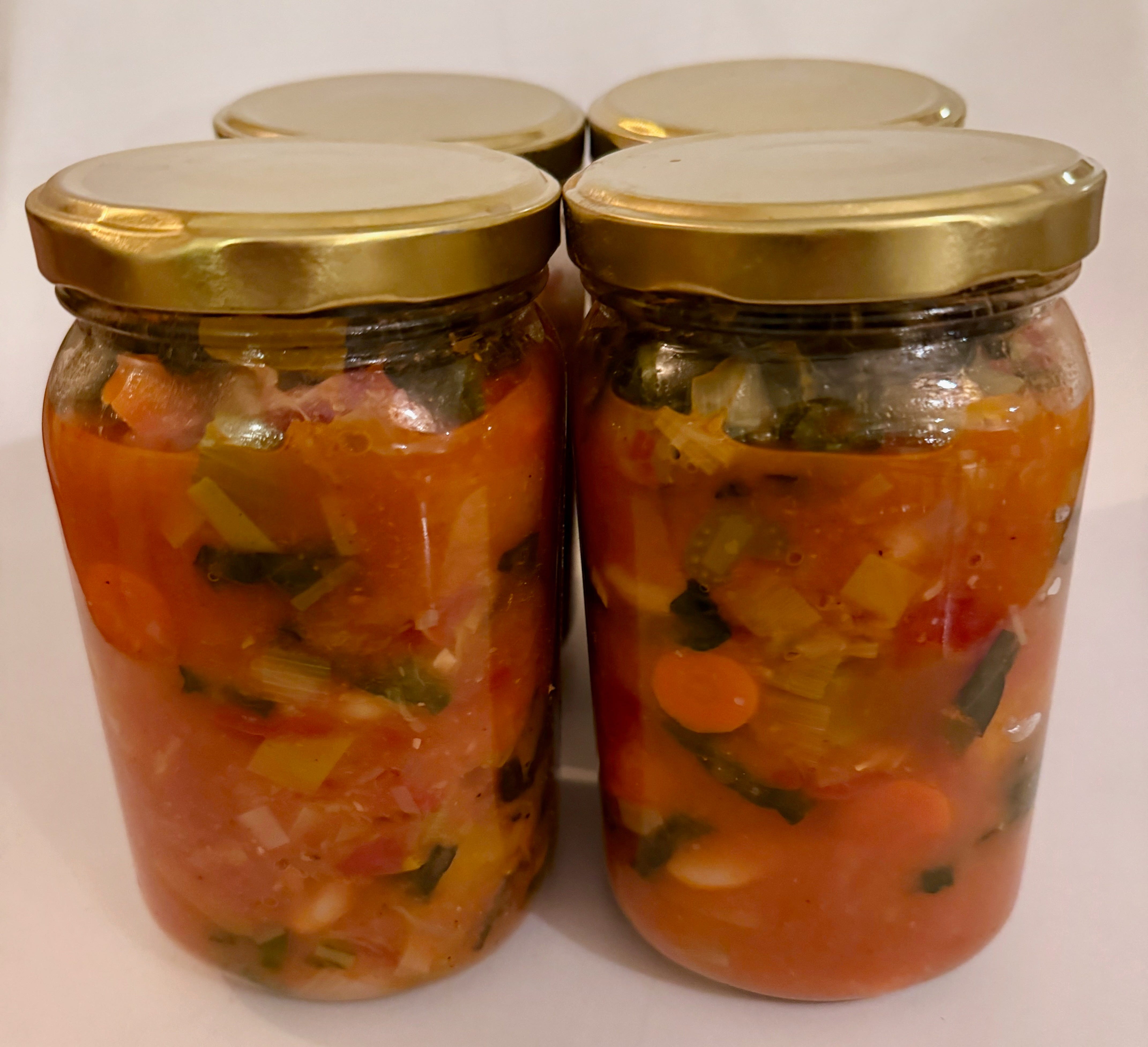
Ingredients
2 TBS extra virgin olive oil
1 onion, chopped
4 carrots, sliced
5 celery stalks, sliced
2 leeks, white and pale green parts only, sliced
2 garlic cloves, chopped
1 quart chicken stock + 2 cups water (or sub bone broth for more protein, or veggie stock to make it vegan)
28oz can chopped tomatoes
1 TBS tomato paste
15 oz can white kidney (cannellini) beans, drained and rinsed well (I like beans, so sometimes I used 2 cans)
1 bunch kale, destemmed and sliced
10 oz butternut squash (can use frozen or pre-cut to save time)
Salt and freshly ground black pepper, to taste
Splash of sherry vinegar
2 TBS grated Parmesan (optional), for serving
Red chile flakes (optional), for serving
Directions
Heat the oil in a soup pot over medium-low heat. Add the onion, carrots, butternut squash and leek and cook until softened but not colored. Add the garlic and cook for 1 minute. Add the stock, tomatoes and their juices, and tomato paste.
In a bowl, mash half the beans with a fork and stir into the pot. Bring to a boil over high heat. Return the heat to medium-low and simmer for 30 minutes.
Add the remaining beans and kale and simmer for 30 minutes more. Taste and add salt, pepper and a splash of sherry vinegar (to taste).
Top soup with a sprinkle of Parmesan and some red chile flakes before serving, if desired.
The tide
I keep coming back to this image of circulation. There’s an inflow and an outflow. A tide. If I’m always pouring out, I end up empty — resentful, sick, brittle. If I’m always collecting, I end up stagnant — disconnected, inert, slightly self-absorbed in the name of healing.
Sustainable service feels like learning to move with that tide. Tending the vessel and keeping it full enough to pour, and pouring it out so that tending has meaning.
Maybe that’s what it means to serve sustainably: to let care move through us like breath. In, out. Receive, offer. Tend, give. Rest, act.
A rhythm instead of a role. A relationship instead of a performance.
Tend, then offer. Give what’s alive, not what’s perfect.
All outflow, no inflow: depletion. All inflow, no outflow: disconnection. What I’m learning to practice is circulation. Flow. Reciprocity.
Not exactly the model I inherited. Nor the reaction I adopted. But a third way that honors both the vessel and the offering.
I don’t have this figured out. These ideas are still uncomfortably emergent for me. I’m learning as I go, making imperfect soup and ugly muffins, checking in with my capacity, offering what I can when I can. Some days I have more to give. Some days I need to receive. That’s the tide.
What the women in my family taught me: care matters. Show up. Be generous. Build community.
What I had to learn the hard way: you can’t pour from an empty cup. Tending yourself is not selfish. Your needs matter too.
What I’m teaching myself now: two things can be true. The vessel needs tending AND the offering needs making. It’s not one or the other. It’s both/and.
In, out. Give, receive. Tend, pour. Rest, act.
Not extraction. Not stagnation. Flow.
What I’m sitting with
This is the heart of body partnership work. It starts with befriending your vessel — knowing its rhythms, honoring its capacity, tending its needs. But it doesn’t stop there. That tending becomes the foundation for sustainable participation in the world.
You learn to move fluidly between tending, containing, and offering. You practice discernment in real time. You let service be imperfect and alive.
Some questions to explore:
What patterns around giving and care did I learn growing up? What did I see modeled — and what was missing?
Where am I in the cycle right now — tending, containing, or offering?
What privileges, resources, or abundance do I have right now that could flow outward?
What does my body need today to feel resourced?
What’s one act of imperfect service I could offer?
How do I discern between generative discomfort and depletion?
How do I know when I’m performing care versus participating in it?
If this post resonated with you, it would mean so much if you would like it, share it with a friend, and subscribe if you haven’t already! All of my posts are available with a free subscription, so no need to pay unless you feel moved to.
Beautiful, Lindsay! As I deal with the humanness of my body while waiting for a date for surgery, this is a much-needed reminder. Thank you!